Delaying Aging (Manila Bulletin)
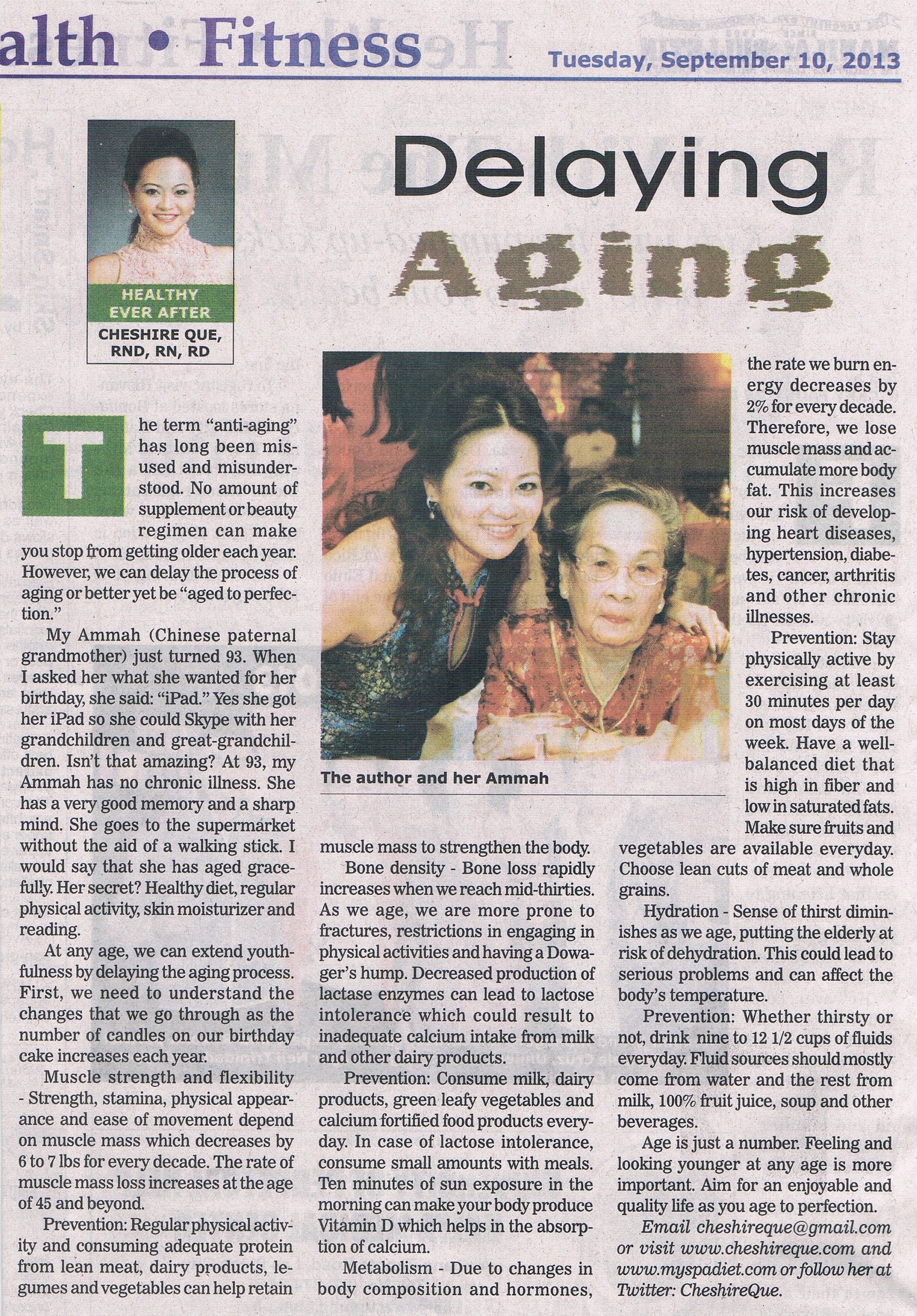
My article featuring my 93-year old grandmother
My article featuring my 93-year old grandmother

Orange Juice
My late grandfather had colon cancer and his passing away was a wake-up call to me and my brother. I eat my fruits and veggies everyday. If these are unavailable, I take my supplements to make sure that I meet my daily vitamins, minerals and fiber requirements. My only brother, on the other hand, prefers to drink his veggies. Years ago, I used to watch him as he drank his canned vegetable juice over dinner. It looked disgusting so I asked him: “How does it taste like?” He replied: “Tastes like spaghetti sauce. It’s good!” I thought, yuck!
Is juicing healthy and beneficial? Yes and No
According to Jennifer K. Nelson, R.D., L.D., a Mayo Clinic nutritionist, there’s no sound scientific evidence that extracted juices are healthier than the juice you get by eating the fruit or vegetable itself.
Juicing can easily make your body absorb nutrients but it lacks fiber. Some juices contain more calories from added sugar and flavoring which could add to weight gain. Fruit juice has a higher glycemic index compared to a whole fruit. It rapidly increases your blood sugar level which could be a problem for people with Diabetes.
Juice Fast
Recently, juice fasting has been gaining much popularity. People try it for many reasons: detox, weight loss, antioxidants and so on. Last week, fitness coach Teem Partosa of SkyFitness Makati asked me: “My client wants to go on a juice fast. Can we still have the same workout program?” A juice fast can take from one to seven days. It is low caloric and does not contain much protein which is also needed to be replenished right after a workout. The amount of energy intake and output as well as medical condition should be carefully considered under the supervision of a health professional before undergoing juice fast and exercising to prevent any health problems. Weight loss after a juice fast will not be sustainable unless succeeded by a lifestyle change which includes proper food intake, increased physical activity and behavior modification. Prolonged juice fasting can also cause nutrient deficiencies.
Juice Right
Juicing can’t be all that bad. There are some practical reasons and health benefits we can get from it. If you don’t like eating fruits and vegetables, juicing can be a part of a healthy diet. Mixing a fresh apple and carrot with a teaspoon of honey over some ice cubes can do the trick and make you appreciate fresh produce more.
Retain the pulp – Use a blender instead of a juicer to get the health benefits of pulp or fiber from your fruits and vegetables.
Choose 100% – If you prefer to buy commercial juice products, choose 100% fruit and vegetable juices. It has no added sugars. Best options would be the ones with pulp and fortified with vitamins and minerals. Remember to read nutrition label, sodium content and practice portion control to avoid excessive intake.
Be Safe – To prevent bacterial growth and food poisoning, properly wash hands and use clean utensils in preparing your juices. Only prepare the amount of serving you can consume at one time to ensure freshness. Store at low temperature and consume right after or within a few hours.
Happy juicing!
For comments and suggestions: email [email protected] or visit www.cheshireque.com
Twitter: CheshireQue

A guide to workout nutrition
PRE-WORKOUT NUTRITION
I was hungry so I devoured a huge chicken gyro and went straight to my Ashtanga Vinyasa Yoga class. Big mistake! I was trying to keep myself from doubling over while trying to perfect my asanas. The chicken gyro in my tummy felt like they’ve come alive and wanted to come out.
You see, it’s very important to prepare for your pre-workout snack and it’s more important to plan when to eat it too!
Food and fluid are essential to fuel and sustain you for a successful workout. An hour or two before exercise, eat a light snack that has a combination of carbohydrates and some protein. Carbohydrates are the primary source of energy for the body while protein is used for muscle growth and repair.
Here are some good choices for a pre-workout snack:
– Low-fat milk
– Yogurt
– Fruit and Nuts
– 100% fruit juice
– 1/2 of peanut butter sandwich
– Sports bar (approximately 100 to 150 kcal per serving)
– Granola bar
POST-WORKOUT NUTRITION
Say what?! Eat after exercising? That doesn’t seem to make much sense right? If you’re trying to lose weight then you shouldn’t eat right after a workout. You will just consume the calories you’ve burned after that grueling one-hour or so of near death experience in the gym – WRONG!
According to Leslie Bonci, MPH, RD, CSSD, LDN, a Registered Dietitian and Director of Sports Nutrition at the University of Pittsburgh Medical Center in Pennsylvania, it is important to start to replace the fuel to speed recovery as well as to replace fluid losses within 15 minutes after exercise.
The need for post-workout nutrition is not an excuse for binge eating or indulging in a hearty buffet. I hear this a lot: “I can eat that large fries now anyway I exercised a lot today!” Whether on a weight loss or weight maintenance program, the pre and post workout snacks should be included in the daily total caloric allowance needed by the body. Otherwise, you will gain weight and your efforts at exercising and dieting will be futile.
Here are some good choices for post-workout snacks:
– 1/2 cheese or chicken sandwich
– Trail mix
– Yogurt with fruit
– Fresh fruit shake with low fat milk
– Sports bar (approximately 100 to 150 kcal per serving)
– Sports drink
– Whole wheat crackers and low fat cheese slices
– Multigrain cereal with low fat milk
REHYDRATION
Lastly but most importantly, remember to keep yourself hydrated at all times. Drink about 1 to 2 cups of water one hour before exercise and another 2 to 5 cups of water for every hour of exercise. It is best to take gulps instead of sipping the fluids to ensure that you get a lot of water into your body. When your body feels warm and you feel like you’ve sweated a lot, don’t attempt to cool down by pouring the contents of your water bottle onto your face or body. Drink it! Rehydrating your body means having water inside the body and not outside.
For comments and suggestions: www.cheshireque.com or Email: [email protected]
Twitter: CheshireQue
According to a study published by the American Journal of Clinical Nutrition in 2005, people who dine out less than 2.5 meals per week tend to keep off the pounds they have lost.
Most Filipinos love to eat out with family and friends. So why deprive yourself of good food and good company? It is safe to say that even when trying to lose weight or maintain a healthy weight range, dining out once in a while is acceptable. However, let me give you some tips on healthy restaurant eating:
PLAN what to order. Most restaurants have menu lists on their websites or at the entrance. Take some time to study the menu description taking into consideration the cooking method before deciding what to order. Choose dishes that are baked, steamed, roasted, boiled, grilled, or pan-seared and avoid deep fried and breaded stuff.
My mom and I love Italian food but she doesn’t want to eat all by herself. One day I asked her why. She said: “I don’t understand Italian and their menu contains words I couldn’t understand.” So I replied: “It’s ok mom! I don’t understand those words either that’s why I always ask!” Which leads me to my second tip for you…
ASK and be informed – Some people would risk ordering stuff which they don’t understand rather than setting aside their shyness and ask the servers or the chef about it. Most of the time they end up dissatisfied and disappointed.
Recently, I went to have dinner with my best friends and while going through the menu, I boldly asked if I could speak to the chef since it wasn’t a busy day for the restaurant. Lo and behold, Chef Martin of Chateau 1771 approached our table and spent a few minutes indulging my curiosity about their menu. He taught me how to tell the difference between a salmon and a trout. I was surprised to know that gravlax means cured salmon and all the while I thought I was eating smoked salmon in my salad.
I don’t go out of my way to annoy chefs and servers with my questions each time I dine out but it’s really a nice experience to ask and learn from the experts occasionally.
Don’t be afraid to request for alternative ways to prepare your food with less fat or sugar. For example, you can ask for your salad dressing to be served on the side instead of eating a salad swimming in too much dressing. If available, ask for brown rice instead of fried or plain to increase your fiber intake.
SHARE or split portions – It is more fun and economical to share entrees and appetizers with your friends. You consume less calories when you share and you get to enjoy a variety of dishes instead of trying to stuff yourself full with a large portion serving of just one dish. Let me illustrate further: I only eat beef once a month. But when I do, I make sure it’s premium steak.
However, I can’t eat the usual 9-ounce serving so I ask for it to be split into two and order a side salad and pasta, both dishes also split for two so I can share it with a friend.
I hope these tips will make you feel less guilty when eating out and I encourage you to PLAN, ASK and SHARE in order to promote healthy restaurant eating.
For comments visit www.cheshireque.com or email [email protected]
Twitter: CheshireQue

The Love Affair
We were together since I was a child. We have been together through thick and thin. It made me feel better when my hormones were acting up. Just like me, perhaps you’ve caught yourself craving for it after a stressful day at work or during the time when someone broke your heart. It had always been a part of happy occasions and celebrations of milestones in my life. This Nutritionist-Dietitian is about to reveal the object of her healthy addiction – Chocolates!
The Forbidden Love
Remember the old wives’ tale about getting zits whenever you’re in love? Well I’ve been told many times that I shouldn’t eat chocolate because it causes acne, it will make me fat and the list just goes on and on. I felt like a young girl running away with her beau every time I give in to my craving for chocolate. I felt guilty afterwards. Until one day, I realized that chocolate is not bad at all. It’s losing self-control that is detrimental to my health.
A Very Special Love
What makes chocolate so special? Recent studies have shown that contrary to what we believed in, chocolate has a number of health benefits. It has protective properties against heart diseases and cancer. It contains phytonutrients called flavonoids. Phytonutrients are plant nutrients that have health benefits beyond basic nutrition. Cocoa beans are rich in flavanols, a type of flavonoid, which are considered powerful antioxidants. Antioxidants are substances that protect body cells from the damaging effects of free radicals which are known to cause the development of diseases.
Matters Of The Heart
You ask: “How can chocolate be heart healthy when it contains fat?” You’re right. It does contain 50% fat in the form of cocoa butter. It is mostly made up of saturated fat which has always been thought of as the culprit in raising cholesterol levels. However, stearic acid, the saturated fat abundant in cocoa butter is miraculously turned into healthy unsaturated fat in our bodies. A study published by the American Journal of Clinical Nutrition in 1994 showed that unsaturated fat does not have a negative impact on the cholesterol level.
Flavonols lower blood pressure and prevent the clumping of platelets (blood cells) that can impede blood flow. Having efficient blood flow will supply our body organs with sufficient oxygen and nutrients to keep them functioning well.
Sweets For My Sweet
Traditionally, chocolate has always been a no-no for people with diabetes. However, a study published by the American Journal of Clinical Nutrition in 2004 suggested the possibility of increasing insulin sensitivity and controlling blood sugar levels. Therefore, chocolate can fit into a healthful diet that will not dramatically increase blood sugar level.
Now back to the issue of chocolates and acne. The antioxidants found in cocoa also protect our skin from being damaged by oxidation. In 1970, the Journal of the American Medical Association stated that “diet plays no role in acne treatment in most patients… even large amounts of chocolate have not clinically exacerbated acne.” Simply put, chocolate does not cause acne! So there ladies and gentlemen, stop blaming chocolates every time a zit pops out.
Healthy Ever After
How much flavonols do we need to get all these health benefits? Unfortunately, no official recommended daily amount has ever been released. However, studies have shown that an intake of 150 to 200 mg of flavonols per day have beneficial effects on blood pressure, inflammation and blood vessels. All of these factors are related to heart health. Here’s a list of some foods and their flavonol content:
Dark chocolate, 40g (1.4 oz.) – 517 mg
Milk chocolate, 40g (1.4 oz.) – 108 mg
Apple, 1 medium-size – 229 mg
Grape juice, 1 cup – 124 mg
Red wine, 5 ounces – 91 mg
Black tea, 6 ounces – 24 mg
It is not easy to determine the amount of flavonols in our food but here’s a simple tip to remember: The higher the amount of nonfat cocoa (%cacao or %cocoa) written in the label, the higher the amount of flavonols.
Now, as this chocoholic ends her confessions for today, let me remind you that no matter how much benefit we can get from cocoa or chocolate, it still contains calories. Be mindful of how much you eat. Practice portion control. Anything in excess will end up being stored in places you wouldn’t want them to be in. As for me, two to three tiny pieces a day will suffice.
For comments and suggestions: Twitter: CheshireQue or visit www.cheshireque.com
Could you be a Doubtful Dieter? Let’s see!
In my 11 years of being a dietitian consultant, I have met a number of men and women who felt hopeless about achieving a healthy weight range after trying different types of diet and weight loss products. This hopelessness often results to an attitude that is detrimental to one’s health – that is, totally giving up on pursuing a healthy lifestyle. Unhealthy eating habits; physical inactivity; inability to cope and manage stress; and negative perception may contribute to the development of chronic diseases like diabetes, heart diseases and cancer.
A client once told me that she already tried everything to lose weight but she was not successful in maintaining it. She said: “I don’t think my body will respond to our weight management program either! Nothing works for me.”
She has a point. Some diet programs work and some don’t. Some may be initially effective but not sustainable thus causing a dieter to regain more weight.
Let’s consider one scenario: You and your friend are doing exactly the same diet program. However, your friend loses five pounds in one week and you’re pea green with envy because you lost zero pounds despite the near starvation state you are in. Now comes the big question, WHY?! What went wrong? Frustrating, isn’t it?
There are two things we need to keep in mind when we catch ourselves in this situation:
Be realistic – You did not gain weight overnight so don’t expect to lose weight overnight. Healthy weight loss is 0.5 to 1 pound per week. If you lose more than that then you’re blessed with a body that responds well to a good diet and increased physical activity.
You’re unique – the saying “one size fits all” is not applicable to dieting. There is no specific diet that can make everyone lose the same amount of weight at the same time. Our metabolism, genetic makeup, health condition and lifestyle vary therefore the way we consume and utilize energy also varies for each person.
Dear Doubtful Dieter, do you now see things from my point of view? Well, it doesn’t end there. Let that Doubtful Dieter have even just a tiny bit of hope once again. Something has to be done.
The key to losing weight and effectively maintaining it is – PERSONALIZATION
A person’s diet should be suited to his or her lifestyle. There are several factors that need to be considered like the individual’s energy requirements, level of physical activity, health condition, food preference, food availability, culture, beliefs and schedule.
One of the things I don’t like to hear is this: “I don’t eat after 6pm.” This is okay if you sleep by 9pm but if you work until the wee hours of dawn then this habit will not only make you very hungry by midnight but will also deprive you of nutrients. Deprivation will lead to binge eating, which in turn will make you gain more weight. Plan your meals according to your own schedule to make sure you are well nourished throughout the day or night. Just remember not to eat less than three hours before you go to bed. Our metabolism slows down when we’re asleep so we don’t efficiently burn excess calories.
Losing weight may be challenging to most of us but it is not impossible. Remember to take it one step at a time and adapt a positive attitude by focusing on your progress no matter how small it may seem. It is best not to compare yourself to anyone else. Assess and appreciate how far you’ve come along. It may take weeks, months or even years to achieve your health goals but you only have two choices: to be disease-free or sickly. Which one would you choose today?
Imagine yourself in a fancy restaurant drooling over a delectable calorie laden chocolate cake. Yes, you heard me. Drooling. That’s all you can do because you refuse to indulge yourself lest you feel guilty after.
A few years back, someone said this to me: “Why are you eating chocolates? You’re a nutritionist!” Well, nutritionist-dietitians are human beings. We have food cravings and our needs are the same as everyone else’s. Agree?
“Rice makes me fat!” I hear this a lot from my clients. Welcome to the Philippines where rice is a staple food. Why do we keep blaming rice for our weight gain? It was never the rice’s fault. There’s no one else to blame but the person who ate too much rice!
We live in a society that categorizes food as “good” or “bad.” Is there such thing as good or bad food? I don’t think so! However, there’s such thing as unhealthy eating habits.
Like many people, I have been through a cycle of deprivation and overindulgence in the past. I “swing” between eating “bad” foods until feelings of guilt creep in and compel me to eat “good’ foods. Sounds familiar? This pattern of unhealthy eating will always leave one feeling unsatisfied.
In my journey of battling weight challenges during my thyroid problem years ago, I have discovered that the key to successfully achieving and maintaining a healthy weight range is to understand this:
“Eating should be pleasurable and dieting doesn’t mean starving oneself.”
Once “off-limit” foods can be a part of a healthy eating plan to ensure that one is not deprived which could lead to binge eating and weight gain. However, it is important to observe portion control. Instead of devouring an entire slice of that sinful chocolate cake all by yourself, take a few bites and share the rest with your family or friends. Sharing food and calories will not only satisfy but also make you feel less guilty. I hope!
Craving for something salty? Instead of grabbing a large bag of potato chips, take a handful and keep the rest out of your sight. Better yet, choose baked chips or plain popcorn which is a good source of fiber.
Sweets, chips and the like can be enjoyed in moderation once in a while as long as it is within your daily caloric allowance. Remember that these are treats meant to be eaten occasionally and not considered as staple food. What then should balance out eating these types of foods?
Eat mostly fruits and vegetables, whole grains, lean meat, low fat dairy products, nuts and seeds, and vegetable oils. Stuff some people may consider tasteless and boring.
A client once told me that whole wheat bread tastes like cardboard. A friend who wanted to go on a diet started to eat salads the whole day until finally she said that she felt like a cow eating grass!
Healthy eating need not be boring. Be creative! Make healthy, flavorful and easy-peasy food combinations. Here are some suggestions:
Boring: Plain oatmeal
Creative: Oatmeal with honey, fruit slices and nuts
Boring: Baked chicken breast
Creative: Roasted chicken with brown rice
Boring: Vegetable salad
Creative: Vegetable salad with low fat dressing topped with croutons
Boring: Plain yogurt
Creative: Fruit cup topped with yogurt and nuts
Boring: Whole wheat bread
Creative: Tuna with pineapple sandwich
Boring: Apple
Creative: Apple slices with reduced-fat peanut butter
Boring: Whole wheat crackers
Creative: Whole wheat crackers with low fat cheese
Forget extreme dieting and deprivation. Try and discover the gastronomic world of guiltless and pleasurable healthy eating now!
Twitter: CheshireQue
Email: [email protected]
I have fond memories of playing “pretend” tea parties with my childhood best friend Cathleen while giggling over our crushes. Inspired by the Mad Hatter’s tea party from “Alice In Wonderland,” I grew up loving morning, afternoon and evening tea moments shared with a friend or simply by myself.
Next to water, tea is the most common beverage choice worldwide. All types of tea, whether green, black or oolong, come from one plant known as Camellia Sinensis. Color and flavor variations depend on processing methods used to produce tea.
Black Tea – exposing leaves to air causes them to turn deep red-brown in color. Black tea imparts a rich flavor. This is popular among Western countries and is used as a base ingredient for specialty teas. My favorites are the fragrant and citrus-flavored Earl Grey and Lady Grey. These are blended with Bergamot Orange, Seville orange and lemon.
Green Tea – leaves are simply heated or quickly steamed to preserve the green color. Green tea has a delicate flavor and is popular among Oriental countries like China and Japan.
Oolong Tea – a traditional Chinese tea that is “between’ black and green tea. Tea leaves are withered or allowed to wilt under the heat of the scorching sun.
Health-TEA Benefits
Tea houses and lounges are getting popular nowadays. Health claims about teas are emerging which led a lot people to ask me this question: Is tea beneficial or harmful to our health?
Tea has potential health benefits because it contains an antioxidant known as Flavonoids. Some studies have shown that tea’s flavonoids may reduce risk of developing gastric, esophageal and skin cancers. Brewing at least 3 minutes will bring out most of the flavonoids. Drinking 4 to 6 cups of tea a day may offer protective properties for the heart to prevent heart diseases and stroke. Tea also helps in cleansing the digestive system and is helpful when experiencing diarrhea.
Unhealth-TEA Precaution
Despite the apparent health benefits of drinking tea, there are some factors considered to be detrimental to health:
1. Be careful when taking tea formulas for weight loss. Excessive intake may lead to dehydration and electrolyte imbalance due to its diuretic and laxative effect. Frequent urination and bowel movement can make one lose weight but will cause nutrient malabsorption and depletion.
2. People taking blood thinning medications such as aspirin should avoid drinking tea at the same time. Both prevent platelets from clotting which increases the risk of bleeding.
3. When taking Monoamine Oxidase Inhibitors (MAOIs) for treatment of depression, tea should be avoided because it can cause a severe increase in blood pressure called “hypertensive crisis”
4. Bottled and canned tea drinks contain added sugars like sodas. Read the nutrition label to know how much calories there are per serving. Excessive intake could lead to weight gain.
Crea-TEA-ve Drinking
• Scared of consuming too much calories? Skip the sugar cubes and honey. Instead, flavor your tea with a slice of lemon, lime or calamansi. You can also add fresh ginger or mint leaves too! These natural alternatives will not only add flavor but will also soothe your senses with their aromatic scents.
• Add 100 percent citrus juices for flavor. The Vitamin C-rich fruit juices will counteract the action of the flavonoids which inhibit the absorption of non-heme iron we get from grain products, legumes, green leafy vegetables and eggs.
• Add low-fat milk instead of creamer to your hot or cold black tea drink to increase calcium intake.
So while the world is waiting for more studies to prove the health benefits of tea, go ahead and enjoy a cup or two when you wake up, while at work, in an afternoon tea with friends, after dinner with your love ones, or simply alone during your quiet moments. A cup of tea goes a long way for me and I wish to share this TEA-lightful experience with you.
“You can never get a cup of tea large enough or a book long enough to suit me.” – C.S. Lewis
(Hailing from Zamboanga City, 33 year-old Cheshire has worked with elite level of individual clients, celebrities and consultant for prestigious companies. She is also the CEO of A-List Professional Health Consulting Co. Write her through [email protected].
When I was young, my mom used to give me a glass of milk and ‘Flintstones vitamins‘ everyday. She said it would make me healthy. At a very young age, my sister-in-law ate raw tomatoes daily because her mom said it would make her cheeks rosy and pretty.
Have you ever eaten a food because someone said it will make you more beautiful, healthier or even help you become an honor student?
Is there any truth behind all these claims about super foods? Let’s take a peek into the world of functional nutrition where foods have health benefits beyond basic nutrition. They are known as functional foods.
According to the Academy of Nutrition and Dietetics formerly known as American Dietetic Association, functional foods furnish energy; sustain growth; maintain and repair vital processes in the body; reduce risk of developing diseases; and promote optimum health.
Functional food is different from dietary supplement which usually comes in the form of capsule, pill, tablet, liquid or powder. There are various types of functional foods but let us focus on conventional or whole foods. These are unmodified whole foods like fruits and vegetables rich in bioactive compounds that influence body processes and functions.
What makes food functional? Phytonutrients or phytochemicals found in plant based foods are starting to play a big role in preventive health. How do they work? Phytonutrients act as antioxidants in the body which promotes healthy and beautiful skin among others. They also enhance immunity and communication among body cells; kill cancer cells; detoxify; and repair damaged cells thus preventing the development of cancer, heart disease and other chronic health conditions.
In retrospect, I should have listened to my mom’s endless nagging about eating fruits and vegetables when I was a kid. I could have been the “fairest of them all.” It’s never too late to start choosing foods that have the potential to make you healthier and more beautiful.
Phytonutrients are found in fruits, vegetables, legumes, whole grains, nuts, seeds, teas, herbs and spices.
Grapes and Wine – contain a powerful antioxidant known as resveratrol that has been proven to promote a healthy heart.
Soybeans, Tofu and Soy milk – contain isoflavones which have estrogen-like properties that promote bone and heart health. Recent studies have shown that it could also help reduce menopausal symptoms among women.
Whole Grains, Nuts and Seeds – help control blood sugar level and neutralize free radicals that are harmful to the body.
Garlic, Onion and Chives – contain allyl sulfides that enhances immunity, detoxifies and promotes heart health.
Cranberries, Cocoa and Cinnamon – good for prevention of urinary tract infection and heart diseases.
Walnuts – contains the fatty acid omega-3 which has been proven to decrease triglyceride levels. It also promotes heart and brain health. Recent studies have shown its potential in decreasing inflammation.
Apples and Teas – also contain flavonols that help reduce bad cholesterol or LDL.
Yellow, Orange and Green Vegetables – promotes healthy vision.
Tomatoes – contain lycopene that can protect men against prostate cancer.
Psyllium and Oatmeal – contain soluble and insoluble fiber that have been proven to reduce cholesterol level as well as cleanse the digestive system.
Broccoli and Cruciferous Vegetables – enhances the immune system.
Kiwi – contains lutein that promotes healthy vision.
There are so many foods that can be considered functional. To ensure that we get our daily dose of phytonutrients, here are some tips to help you:
• Color your plates with fruits and vegetables
• Eat brown rice and whole grain cereals instead of refined grains
• Drink soy milk and replace high fat meat with tofu once in a while
• Drink a cup of green tea daily
• Top cereals with walnuts or add them to your sauce recipes when cooking
• Use garlic and onions to add flavor when cooking instead of using artificial flavoring.
A seasoned dietitian consultant for 10 years, Cheshire Que’s services include Medical Nutrition Therapy and Lifestyle & Weight Management programs for clients afflicted with lifestyle related diseases. One of her most recent achievements is pioneering of the first online diet tool in the country, www.myspadiet.com and My Spa Diet to Go! a complete wellness program with meal deliveries and antioxidant formulas. She is also the CEO of A-List Professional Health Consulting Co.
